
If you are thinking about selling property in Bali in 2026, the first question is not simply whether there is demand.
The better question is whether your property is properly positioned to sell well.
Bali remains an active and highly competitive property market, but that does not mean every asset sells easily, or at the price the owner hopes to achieve. In practice, successful sales depend on a combination of factors: title structure, pricing, paperwork readiness, market positioning, buyer qualification, the selection of the right agent, and disciplined transaction execution. These factors matter just as much as general market sentiment.
In many cases, the biggest obstacle is not a lack of buyer interest in Bali itself, but incorrect pricing at the outset. Sellers often begin the process with an asking price that is not aligned with qualified demand. The property may attract attention, casual enquiries, or speculative interest, but not the serious buyers who are actually in a position to transact. The result is familiar: the asset remains on the market for too long, loses momentum, and only begins to move once the pricing is adjusted.
This issue is especially common in Bali because trustworthy sales data is limited. Comparable transaction evidence is often incomplete, inconsistent, or not publicly accessible, and asking prices seen online are not the same as completed sale prices. At the same time, many owners do not fully trust the pricing advice they receive from agents. That combination — limited reliable market evidence and limited trust in intermediaries — is one of the main reasons properties are frequently brought to market at unrealistic prices.
In this guide, we look at the main legal, commercial, and practical issues sellers should understand before going to market in Bali in 2026.
Is 2026 a good time to sell property in Bali?
That depends on what you are selling.
Broadly speaking, demand remains strong for well-located, well-designed, legally clean properties with a realistic pricing strategy. But the market is not equally favourable to every seller or every type of asset. A properly structured freehold villa in a strong location is a very different proposition from an ageing leasehold property with limited remaining term, incomplete paperwork, or a price that exceeds what the market is prepared to pay.
In practice, marketability depends on the individual asset. Before listing, a seller should be clear on four points: what exactly is being sold, who the likely buyer is, what ownership structure that buyer can accept, and what net result the seller expects after taxes and transaction costs.



What makes a Bali property marketable?
Many owners assume that if a property is attractive and located in Bali, it will sell. That is not always the case.
In reality, marketability usually comes down to a combination of legal clarity, commercial positioning, pricing discipline, presentation, and the choice of the right agent. A property tends to be more marketable if:
- the ownership title is clear and transferable,
- the permits and supporting documents are complete,
- the asking price is aligned with current market conditions,
- the property is presented well,
- the seller has chosen a competent and trusted agent,
- and the sales process is handled in a disciplined way.
This is particularly important in Bali, where buyers are often cautious and due diligence can materially affect the outcome of the deal. Even where initial interest is strong, transactions can stall or fail if title issues, permit gaps, pricing problems, or poor preparation come to light too late in the process.
The first question: what title are you selling?
Before discussing price or marketing, a seller needs to be clear about the legal nature of the asset being sold.
In Bali, a transaction may involve freehold (Hak Milik), leasehold (Hak Sewa), right of use (Hak Pakai), right to build (Hak Guna Bangunan), or a combination of these. The transfer process, tax treatment, buyer profile, timing, and documentation differ materially depending on the title involved.
Freehold (Hak Milik)
If you are selling a property with freehold title, the sale is typically handled through a PPAT (Pejabat Pembuat Akta Tanah), being the authorised official for land transfer deeds. Not every notary is also a PPAT, so sellers should confirm that the appointed notary is properly licensed for the transaction.
The seller is generally subject to seller’s tax of 2.5%, namely PPh Final atas pengalihan hak atas tanah dan/atau bangunan. The parties must also agree how notarial fees and transaction costs are allocated. In some transactions the buyer bears those costs, especially where the buyer appoints the notary, but this is ultimately a matter for agreement.
Depending on the buyer’s legal status and intended holding structure, the title may need to be converted into the form that the buyer can lawfully hold, such as Hak Guna Bangunan, or Hak Pakai. That can affect timing and transaction mechanics and is one reason why sales are often documented first through a binding preliminary agreement before final completion.
Leasehold (Hak Sewa)
Leasehold transactions require special care, not least because the tax treatment is materially different from the sale of registered title.
In practice, leasehold sales are commonly structured either as a sublease to the buyer or through the cancellation of the seller’s lease and the simultaneous grant of a new lease directly from the underlying landowner to the new buyer. Each route has different commercial and tax implications, and the correct structure depends on the terms of the original lease and the agreement reached between the parties.
Sellers should be aware that the tax burden on a leasehold sale is comparatively high. A seller with Indonesian tax residence is generally exposed to 10% income tax (PPh) on the transaction value, which is significantly higher than the 2.5% PPh Final atas pengalihan hak atas tanah dan/atau bangunan typically applicable to the sale of registered title such as freehold. Foreigners with foreign tax residence are generally subject to 20% withholding tax subject to treaty relief. This is one of the key reasons why leasehold exit planning needs to be considered carefully before going to market.
Although leasehold documentation is not always treated with the same formality as registered title transfers, sellers should approach these transactions with the same seriousness. Buyers will often scrutinise the lease structure closely, including the landowner’s role, extension mechanics, consent requirements, and the enforceability of the documentation.
Right of Use (Hak Pakai)
If a foreign individual is selling a Hak Pakai property, their immigration and residential status may need to be reviewed as part of the transaction planning. The transfer process is broadly similar to other registered title transactions and should be handled through the proper authorised officials and documentation.
As with freehold, sellers should not assume that the transfer path is straightforward without first reviewing the buyer’s intended holding structure and the practical requirements of the land office process.
Right to Build (Hak Guna Bangunan)
Where the seller is a company holding Hak Guna Bangunan, the transaction is again similar in principle to a registered title transfer, but company-level due diligence may become more important. Depending on the structure of the sale, the buyer may review not only the land title itself, but also the company documents, tax records, permits, and operational history associated with the asset.
For that reason, HGB sellers should prepare for a more document-heavy process from the outset.
Pricing is often the decisive issue
Pricing is one of the most misunderstood aspects of selling property in Bali, and in many cases it is the decisive factor.
The biggest problem for many sellers is not a lack of demand for Bali property in general, but the fact that the asset is brought to market at a price that qualified buyers are unlikely to accept. That often leads to a predictable pattern: the property sits on the market for an extended period, becomes stale, and ultimately has to be repositioned at a lower or more realistic price.
One reason this happens so often is that Bali does not offer the same level of transparent, trustworthy sales data that sellers may be used to in more developed property markets. Comparable evidence is often difficult to verify, and advertised asking prices are not the same as completed transaction values. On top of that, many owners are sceptical of agent advice, particularly where they suspect that pricing recommendations may be influenced by the desire to win a listing rather than to position the asset correctly from the outset.
For that reason, pricing in Bali cannot be approached casually. It requires judgement, local market knowledge, and a realistic understanding of what qualified demand is actually willing to pay.
A sound valuation approach will usually consider:
- underlying land value,
- replacement cost of the improvements,
- legal and commercial strength of the title structure,
- location and surrounding market,
- remaining lease term where relevant,
- and the likely buyer profile.
For some assets, replacement cost may be a more useful anchor than imperfect comparable listings. In practical terms, the question becomes: what would it cost a buyer to acquire the land and recreate this property today, adjusted for condition, legal structure, and time value? From there, the seller should consider taxes, agent fees, notarial costs, and negotiation room in order to arrive at a disciplined pricing strategy.

Choosing the right agent matters
The choice of agent is one of the most important decisions in the entire sales process.
A strong agent does more than advertise the property. The right representative helps position the asset correctly, advises on pricing, manages the presentation, qualifies buyers, coordinates due diligence, and protects the seller’s negotiating position. In a market where reliable comparable data is limited and seller confidence in intermediaries is not always high, choosing the right agent becomes even more important.
For higher-value properties in particular, exclusive representation can often be more effective than placing the asset loosely with multiple agents. Serious properties typically require controlled marketing, consistent information, careful buyer handling, and disciplined negotiations. If too many agents market the same asset with inconsistent pricing or poor coordination, the property can quickly appear overexposed and commercially weak.
That does not mean every property must be sold under an exclusive mandate. But owners of premium assets should at least consider whether controlled representation is more likely to preserve value than an open-listing approach.
How long should a sale take?
Every sale is different, and sellers should go to market with a realistic timeline rather than assume an immediate exit.
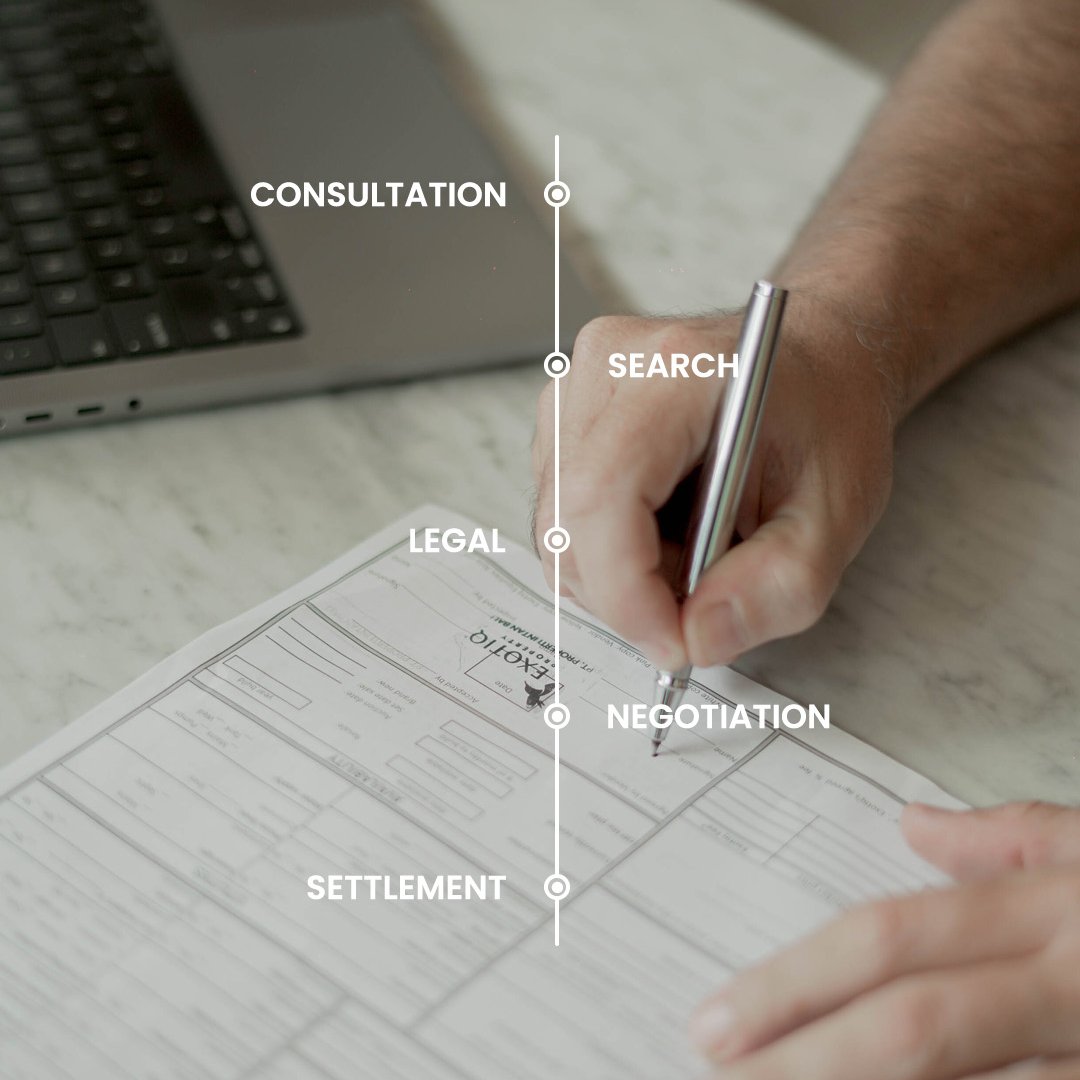
The sales process includes more than just finding a buyer. It also involves buyer qualification, negotiations, document collection, due diligence, contract drafting, tax preparation, notarial handling, and completion. Even after headline terms are agreed, a transaction can still be delayed or fall apart if issues surface during the legal review.
While there is no reliable public data in Bali showing average time on market across different property categories, a disciplined timeline still matters. As a practical rule, a property that is correctly priced, properly presented, and legally clean should generally sell within about 12 months. If it does not, there is usually something wrong with the proposition — most commonly the price, though in some cases the issue may also be title structure, presentation, market positioning, or seller readiness.
Extended market exposure can weaken the perception of the asset. If a property remains unsold for too long without a good reason, the market may begin to assume that the price is unrealistic, the title is problematic, or the seller is not truly ready to transact.
Preparing the property for sale
Presentation matters more than many owners think.
Before launching the asset, the seller should review the property from a buyer’s perspective. That often includes fresh photography, strong hero imagery, a professionally produced video, tidying the grounds, addressing minor repairs, checking lighting, improving access, and making sure the villa feels maintained and ready.
For residential and lifestyle assets especially, the first impression can materially affect the buyer’s willingness to inspect, engage, and negotiate at the desired level.
Marketing materials should also be prepared carefully. Strong visuals are essential, but they are only part of the package. The written presentation should clearly explain the key commercial points: title, land size, building size, zoning, permit status, lease term if relevant, access, views, and any operational or income-related information that matters to the likely buyer.
Have your paperwork ready before launch
This is one of the most important practical steps, and one of the most often overlooked.
Before bringing a property to market, sellers should gather and organise all key documents in advance. That may include title documents, lease agreements, permits, zoning confirmations, tax receipts, utility records, inventories, warranties, invoices, and any other materials that a prudent buyer may request during due diligence.
If documents are incomplete, lost, inconsistent, or only assembled after a buyer is found, the risk of delay increases significantly. In some cases, a transaction that appeared close to completion can fail simply because the seller was not administratively ready.
If you are not always in Bali, you should also think ahead about signing logistics. A power of attorney may be needed if documents have to be signed in your absence, and that process is best prepared early rather than once the deal is already under time pressure.
What happens once you receive an offer?
Once a serious offer is accepted in principle, the transaction typically moves into a more formal stage.
That stage often begins with a reservation agreement or a Conditional Sale and Purchase Agreement (CSPA), under which the parties record the principal terms of the deal while allowing time for due diligence and the satisfaction of agreed conditions. This is typically accompanied by the payment of a deposit, after which the buyer and their advisors verify the legal, technical, and commercial aspects of the asset.
This stage is critical. Sellers should expect requests for documents, clarification on title and permits, confirmation of payment structure, and input from the notary or legal advisers. A well-managed due diligence process materially improves the chance of reaching completion without unnecessary renegotiation or friction.
Once the legal and commercial conditions are satisfied, the parties move to final completion documentation, settlement of the balance purchase price, transfer execution, and handover.
Common mistakes sellers should avoid
Some of the most common mistakes in Bali property sales include:
- Going to market before understanding the legal structure
- Pricing based on hope rather than evidence
- Choosing the wrong agent or failing to control the sales process
- Allowing the property to become overexposed or stale
- Underestimating the importance of paperwork
- Focusing only on gross price instead of net proceeds
- Waiting until a buyer appears before solving practical issues
Most of these problems can be reduced or avoided through disciplined preparation before the property is launched.
Final thoughts
Selling property in Bali in 2026 is not simply a matter of listing an asset and waiting for enquiries.
The strongest outcomes usually come from careful preparation: understanding the title, pricing correctly, selecting the right agent, presenting the property properly, organising the paperwork in advance, and managing the transaction process in a disciplined way from start to finish.
The right strategy is not just about getting a deal done. It is about getting the deal done well.